

What it is, how to calculate it, and why it belongs at the floor of your pricing rather than the center of it.
Cost based pricing sets the price of a product or service by calculating what it costs to produce and deliver, then adding a fixed markup or target margin on top. It is the most common way businesses arrive at a price, and for understandable reasons: it is simple to calculate, easy to defend in a negotiation, and it feels safe. If every unit covers its cost plus a margin, the arithmetic always works.
That same simplicity is the problem. Cost based pricing anchors what you charge to your own costs rather than to the value the customer receives. In B2B markets, where two buyers can derive very different value from the identical product, that gap is usually where margin quietly leaks away. This guide explains how cost based pricing works, the forms it takes, when it is the right tool, and where it costs you more than it protects.
What is cost based pricing
Cost based pricing is an inward-looking method. It uses two inputs: the full cost of delivering the offer, and a markup that represents the profit you intend to earn. The price is the mechanical output of those two numbers. Nothing about the customer, the competition, or the value created enters the calculation.
It helps to place it against the two other broad approaches to setting price. Competitor-based pricing anchors to what rivals charge. Value-based pricing anchors to the buyer’s willingness to pay. Cost based pricing ignores both and looks only at the income statement. That makes it the easiest of the three to run and the most likely to misprice.
How cost based pricing works
The calculation has three steps. First, total your costs. This includes direct or variable costs such as materials, labor, hosting, and fulfillment, plus an allocated share of fixed costs and overhead such as rent, salaries, and tooling. Second, choose a markup percentage or a target margin. Third, apply it to the cost to produce the price.
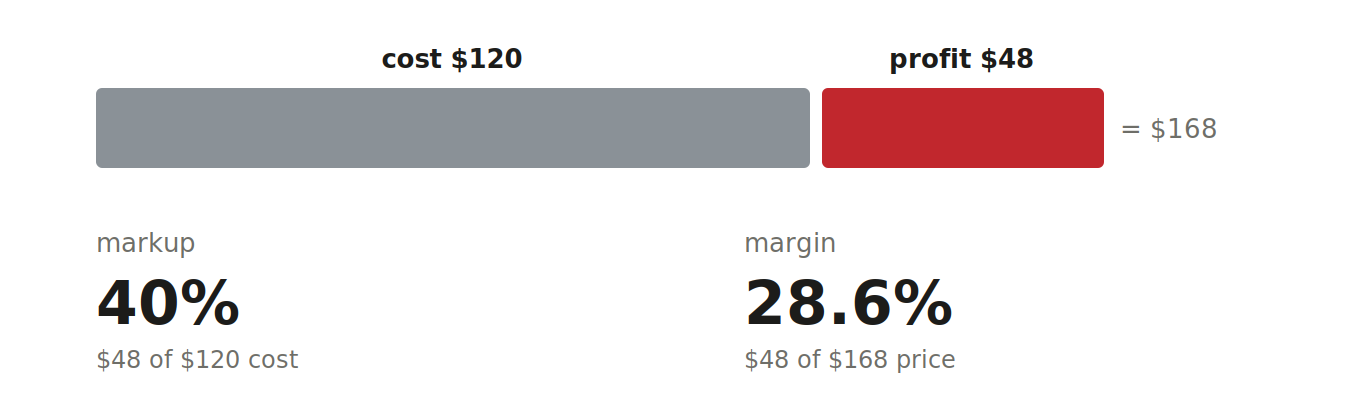
Suppose a company manufactures industrial sensors. Each unit costs $80 in materials and direct labor, and the business allocates a further $40 of overhead per unit, for a fully loaded cost of $120. Applying a 40% markup produces a list price of $168. The formula is straightforward: price equals unit cost multiplied by one plus the markup.

Markup is not the same as margin
This is where cost based pricing trips up even experienced teams. Markup expresses profit as a percentage of cost. Margin expresses the same profit as a percentage of price. They use the same dollars but a different denominator, so they are never equal.
Take the sensor again. A $120 cost sold at $168 carries $48 of profit. As a markup, that is $48 divided by $120, or 40%. As a margin, it is $48 divided by $168, or 28.6%. Reading one as the other is one of the most common ways businesses underprice without realizing it: a team that wants a 40% margin but applies a 40% markup ends up well short of its own target.
The main types of cost based pricing
Cost based pricing is a family of related methods rather than a single technique.
Cost-plus pricing
Cost-plus pricing is the most common form. You add a fixed percentage markup to the fully loaded cost of the product. It is the default in much of manufacturing, distribution, and contract work because it is transparent and quick to apply across a large catalog.
Markup pricing
A close cousin that applies the markup to a narrower cost base, often the cost of goods sold rather than fully loaded cost. It is faster but riskier, because overhead that is not captured in the base can erode the margin you think you are earning.
Break-even pricing
Here you set the price to cover total costs at an expected sales volume. The break-even price is not a strategy on its own; it is the line below which you lose money, and it makes a useful floor before any margin is added.
Target-return pricing
A more disciplined variant in which the markup is sized to hit a required return on the capital invested. It is common where a business must justify pricing to investors or a board, including many PE-backed companies.
Pricing & growth expertise
Expert-led pricing & growth strategy for growth-focused and PE-backed companies.
Enterprise-quality work. Practical recommendations. 6-10 week timelines.
When cost based pricing makes sense
Cost based pricing is not a mistake everywhere. It is a reasonable choice in a few specific situations: cost-reimbursable or regulated contracts where price must be tied to documented cost; true commodities with little differentiation, where the market gives you no room to price on value; internal transfer pricing between business units; and early-stage offers where you simply have no willingness-to-pay data yet. In each case it works because there is little value signal to capture, or because the contract structure demands it.
The common thread is that cost based pricing is a sound floor and a fast default. It becomes a liability the moment it is treated as the strategy itself.
Where cost based pricing leaks margin
The core weakness is that price is disconnected from value. A product that costs little to deliver but creates enormous value gets systematically underpriced, while one that costs a lot but does little gets overpriced into a corner. Markup is bounded by your cost; value is not, so the method caps your upside by design.
It also transmits your cost swings straight to the customer. When input costs fall, you cut your own price for no commercial reason. When they rise, you pass through increases that may exceed anything the market actually required. And it is quietly circular: per-unit overhead depends on volume, volume depends on price, and price depends on cost, a loop that becomes unstable whenever demand shifts.
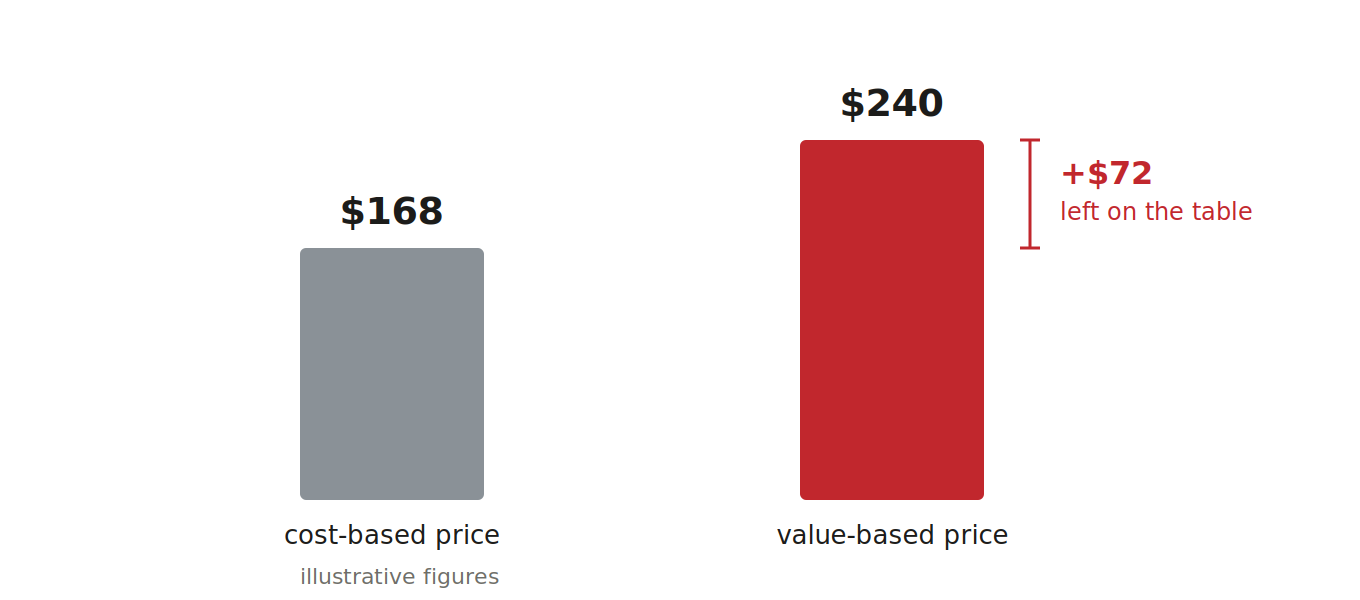
Consider a professional services firm that prices a compliance audit at cost plus 35%. That audit may let a client avoid a regulatory penalty worth many times the fee. Cost based pricing has no way to see that value, so the firm leaves it on the table on every engagement. The revenue leakage is invisible precisely because the math always looks correct.
Cost based pricing vs. value based pricing
The contrast is the heart of the matter. Cost based pricing asks, what does this cost us? Value-based pricing asks, what is this worth to the customer? The first is easy and self-limiting. The second is harder and far more profitable, because it ties price to the outcome the buyer actually cares about and to their willingness to pay for it. For most B2B and PE-backed companies, the path to margin expansion runs through moving away from cost-plus toward a value-based pricing model that reflects the value created.
How to use cost based pricing well
The practical answer is not to abandon cost entirely but to put it in its proper place. Know your fully loaded cost precisely so you never price below it; that is what the floor is for. Then build the actual price upward from market evidence and value rather than from a reflexive markup. A pricing diagnostic will show you where your current cost-plus prices diverge from what buyers are willing to pay, which is usually where the largest gains sit. From there, segment by the value different customers receive, test changes before a full rollout, and put governance around discounting so the margin you set is not quietly given away in the field. If you want to raise prices the right way, the discipline matters as much as the number.
Put cost in its place
Cost based pricing earns its popularity honestly. It is simple, transparent, and safe, and it gives you an essential number: the floor below which a deal destroys value. What it cannot do is tell you what a customer will pay, and in B2B that is where the money is. Use cost to protect yourself, and use value to grow.
Let’s find the margin hiding in your pricing
You don’t need a finished plan or a pricing problem you can already name to start a conversation. If your prices are built on cost-plus, there’s a good chance your strongest products are underpriced and your best customers are paying the least, and the first step is simply seeing where that gap sits. Acustrategy works with B2B and PE-backed companies to map it, rebuild pricing around the value customers actually receive, and roll the changes out without putting key accounts at risk.
If any of this sounds familiar, we’d be glad to talk it through. A short, no-pressure call is often enough to show you where the opportunity is, whether or not you decide to take it further. Reach out to a B2B pricing consultant and we’ll help you see what your current pricing is leaving on the table.
