

The model you choose decides how your revenue grows, long before you ever set a price.
Your pricing model is the structure that decides what you charge for and how that charge scales as customers grow. It matters more than any single price point, because the model sets the ceiling on how your revenue can expand. Choose one that tracks the value customers receive, and revenue grows alongside their success. Choose one that tracks something else, and growth stalls no matter how well you sell. For companies focused on sustainable revenue growth rather than a one-time bump, selecting the right pricing model is one of the highest-leverage decisions leadership can make.
This guide explains what a pricing model actually is, the main models you are choosing between, and a practical way to match one to how your business creates value, so the structure works for you as you scale rather than against you.
What is a pricing model
A pricing model is not the same as your price. The price is the number a customer pays. The pricing model is the logic underneath it: the unit you charge for, how that unit is packaged, and how the bill changes as the customer uses more or grows. Pricing strategy sits above both, setting the commercial goals the model and price are meant to serve.
Three businesses can sell the same software at the same headline price and run three completely different pricing models. One charges a flat annual fee. One charges per user. One charges for the work the software actually performs. On day one all three invoices read the same. A year later, after every customer has grown, the flat-fee business has collected exactly what it started with, the per-user business has collected a little more, and the third has grown its revenue in line with its customers. Same price, same product, three very different trajectories. That divergence is the whole reason the model deserves more attention than it usually gets.
The models you are choosing between
Most pricing models are variations on a handful of underlying ideas, separated by what they charge for.
Flat-rate pricing charges one fee for access, regardless of how much the customer uses. It is predictable and easy to buy, but it leaves money behind as customers grow because the fee never moves.
Per-user pricing, also called per-seat, charges by the number of people with access. It is simple to forecast, but it can cap both adoption and revenue when the value does not actually scale with headcount.
Usage-based pricing charges for consumption, such as transactions processed or volume delivered. Revenue tracks activity closely, though it is less predictable from one period to the next.
Tiered pricing packages features and limits into a few named levels, letting buyers self-select and creating a built-in path to expansion as their needs grow.
Value-based pricing charges for the outcome the customer receives rather than the inputs you provide. It is the hardest to design and the strongest in alignment, because price and delivered value move together.
Subscription billing is worth separating out, because it is often mistaken for a model. Recurring billing is the wrapper. Underneath it you still have to choose what the recurring charge is based on, which is the real decision.
The cleanest way to see how much the model matters is to hold the product and the customer constant and change only the model. Consider a B2B analytics platform serving one customer whose data volume grows fivefold over three years. The figures below are illustrative, but the pattern they show is not.
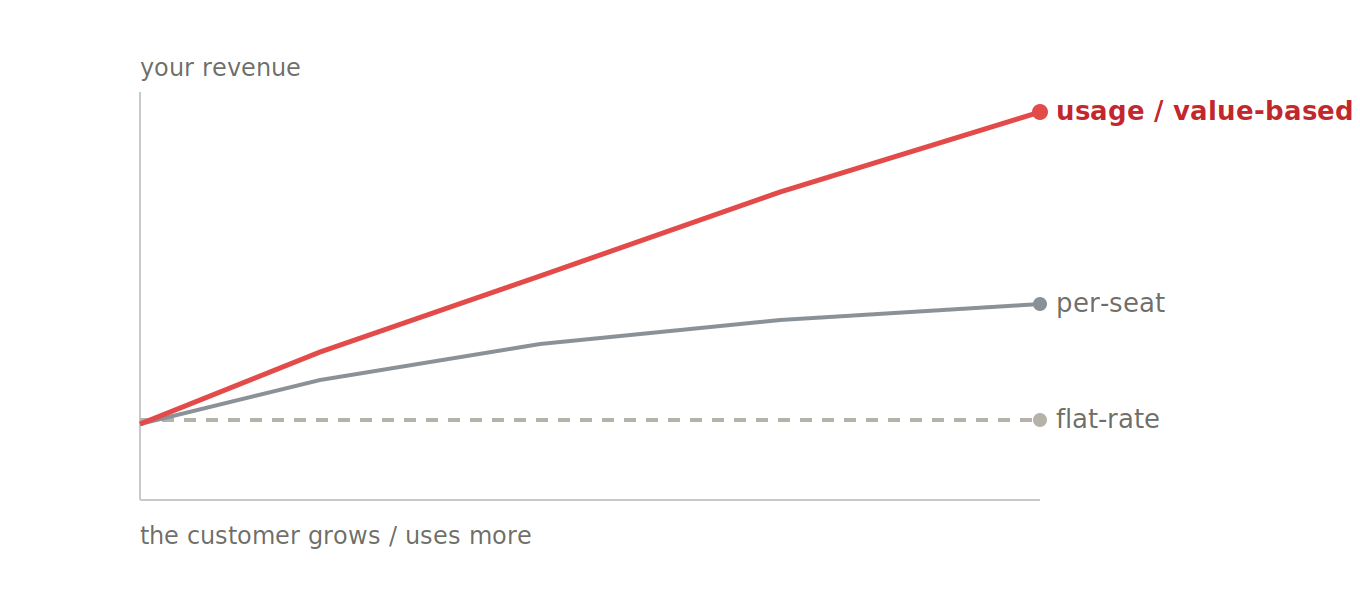
Under a flat-rate model at $30,000 a year, the platform earns $30,000 in year one and the same $30,000 in year three, even though the customer is now drawing five times the value from the product. The model is simply blind to that growth.
Under per-user pricing at $1,500 a seat, the customer starts with 12 users and expands to 16 and then 22 as the team grows, taking the platform from $18,000 to $24,000 to $33,000. Revenue rises, but only at the speed of headcount, which trails the real expansion in how heavily the platform is used.
Under usage-based pricing at roughly $400 per million records processed, the same customer takes the platform from about $24,000 in year one to $72,000 and then $144,000, as annual volume climbs from 60 million records to 360 million. Revenue grows in step with the value the customer is pulling from the product.
Same product, same customer, same three years. In year three the model alone is the difference between collecting $30,000, $33,000, or $144,000. Nothing about the offering changed; only the structure did.
Pricing & growth expertise
Expert-led pricing & growth strategy for growth-focused and PE-backed companies.
Enterprise-quality work. Practical recommendations. 6-10 week timelines.
Your pricing metric is the real decision
Underneath every pricing model is a pricing metric: the unit you actually charge for. The model is the packaging; the metric is the engine. Get the metric right and most models can be made to work. Get it wrong and none of them will.
The test is simple. Does the metric grow when the customer gets more value? Consider a B2B payments platform that charges 30 basis points on the payments it processes. When a customer’s monthly volume grows from $2 million to $10 million as their own business scales, the platform’s revenue from that account rises from about $6,000 to $30,000 a month, without a single renegotiation. The metric is doing the selling. Every dollar of value the customer gains is automatically reflected in what they pay, and neither side has to reopen the contract for that to happen.
Now consider a workforce-scheduling tool that charges $40 per user per month but creates its value through the shifts it helps schedule and fill. A regional operator with 40 schedulers pays the same $1,600 a month whether the software is planning 2,000 shifts or 20,000. As that customer grows busier, the tool delivers many times the value and collects nothing more for it. The only way the vendor expands the account is to send a salesperson back to push for seats the customer does not actually need, which is a hard case to make. The value is real; the metric simply cannot see it.
That gap, between how a customer derives value and what they are billed for, is where willingness to pay goes uncaptured. It is the first thing to examine before settling on any model, because no amount of clever packaging fixes a metric that points at the wrong thing.
How to choose the right pricing model
Choosing well is less about picking a favorite model and more about following the value. Four questions move you most of the way there.
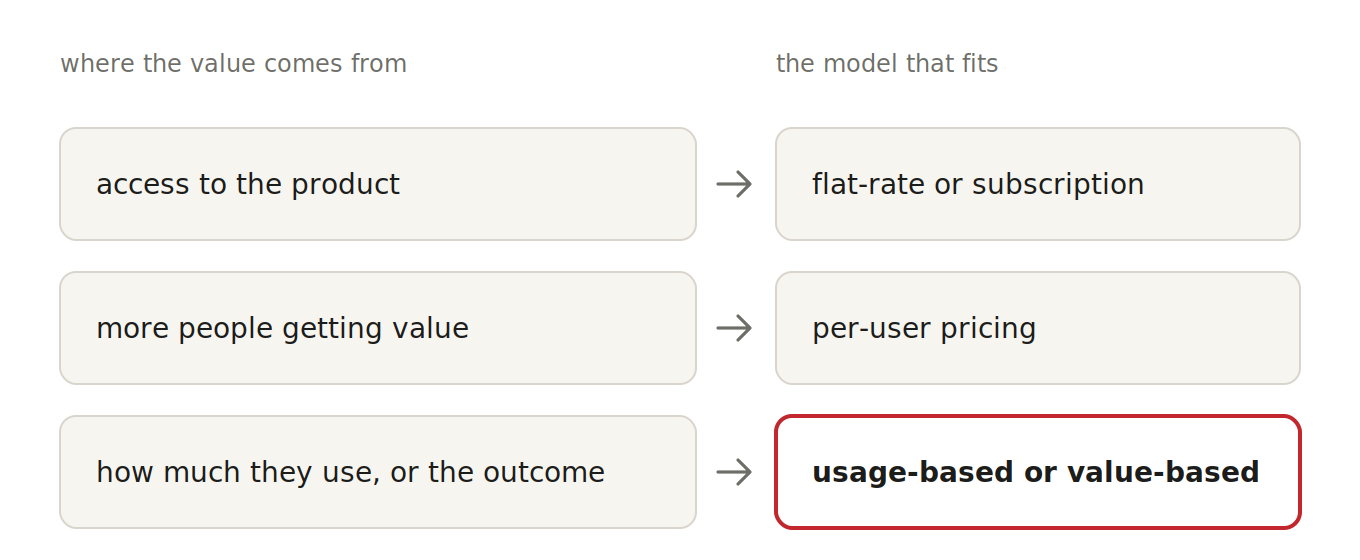
Start with how your customer gets value. Is it from access to the product, from the number of people using it, from how much they use it, or from the outcome it produces? Returning to the analytics platform, its customers clearly got more value as they processed more data, which is exactly why the usage metric tracked their growth and the other two did not. The honest answer to this question points to your metric, and the metric points to the model.
Match the buyer and the sales motion. Self-serve and mid-market buyers reward simple, transparent models they can understand without a call. Enterprise buyers will tolerate usage-based or custom structures when the value justifies the complexity.
Design for expansion, not just the first sale. A model that only grows through renegotiation puts a ceiling on net revenue retention. A model tied to the customer’s own growth expands on its own, which is the difference between chasing every increase and earning it automatically.
Test before you commit. Model the revenue under realistic customer scenarios, run the kind of three-year comparison shown above with your own numbers, and validate that buyers accept the structure before rolling it out across the book of business.
Where the wrong model quietly caps growth
The most expensive pricing mistakes are rarely loud. They show up as growth that should be there and is not. Per-user pricing is a frequent culprit: when value does not really track headcount, the model rations adoption and forces every expansion through a sales negotiation. Flat-rate pricing leaves the upside on the table, because the customer who gets ten times the value pays exactly what the customer who barely uses the product pays.
A concrete version makes the cost obvious. Take a vendor whose software inspects product quality on a manufacturing line, sold as a flat $50,000 annual license regardless of how many lines it watches. When a customer acquires a second facility and the software starts monitoring twice as many lines, the value the vendor delivers doubles overnight, while the invoice does not move at all unless someone remembers to renegotiate. Had the same vendor tied its metric to the number of lines or units inspected, that expansion would have flowed through on its own, the moment the new facility came online.
Pure usage-based pricing carries the opposite risk. Tie all of your revenue to a customer’s volume and your revenue swings with their business, which is why a floor or platform fee usually belongs alongside the variable rate. In each case the model is not broken so much as mismatched, either to how value is created or to how the business needs revenue to behave.
Match the model to the value, then revisit it
A pricing model is a decision you revisit, not one you make once. Markets move, products expand, and a model that fit at launch can quietly cap you two years later, exactly as the flat license did for the quality-inspection vendor. The discipline is to keep the model anchored to how customers actually get value, and to recheck that link as both your offering and their needs change. The right model is rarely the cleverest one. It is the one that lets your revenue grow in step with the value you create.
Not sure which model fits? let’s talk it through
You do not need to have picked a model, or even decided that your current one is wrong, to start a useful conversation. Often the fastest way to see whether your pricing model is helping or holding back growth is to talk it through with people who have worked across dozens of them. Acustrategy helps B2B and PE-backed companies match the model to the value they create and build a realistic path to get there, at whatever pace makes sense. If any of this resonates, we would be glad to hear what you are working on. Reach out to a pricing strategy consultant and we will help you find the model that lets revenue grow with your customers.
