

The price you set is rarely the price you keep. Pricing optimization closes that gap.
Pricing optimization is the ongoing, data-informed work of setting and adjusting prices, discounts, and packaging so a business captures more of the value it creates, without losing the deals it should win. For B2B companies it does two jobs at once: it protects margin that is quietly leaking through discounts and concessions, and it grows revenue by aligning price more closely with the value customers actually receive. Because a change in price flows almost entirely to the bottom line, pricing optimization is one of the highest-return levers a leadership team has, and one of the few that pays back in weeks rather than years.
This guide explains what pricing optimization actually is, why margin leaks in the first place, the levers that move it, and how B2B companies put it to work to protect margin and grow revenue at the same time.
Pricing optimization, defined
Pricing optimization is not a one-time price increase. It is a continuous discipline that keeps prices aligned with value, cost, and competition as all three move. A single increase is an event; optimization is the system that decides what to charge, how much to discount, and when to revisit both.
In practice it spans several connected decisions:
- List and price setting: where your published or target prices sit relative to value and the market.
- Discounting and deal terms: how much of that list price survives the negotiation.
- Segmentation: charging different prices to customers who derive different value.
- Packaging: how features and tiers are bundled to guide buyers toward the right fit.
- Realization and governance: making sure the prices you set are the prices you actually collect.
Done well, these add up to a simple result. You stop giving away margin you did not need to, and you start charging in line with the value you deliver. That is the whole game.
Where the margin actually goes
Most B2B companies do not have a list-price problem. They have a realization problem. The price leadership believes it charges and the price that actually lands in the bank are two different numbers, and the gap between them is where margin disappears.
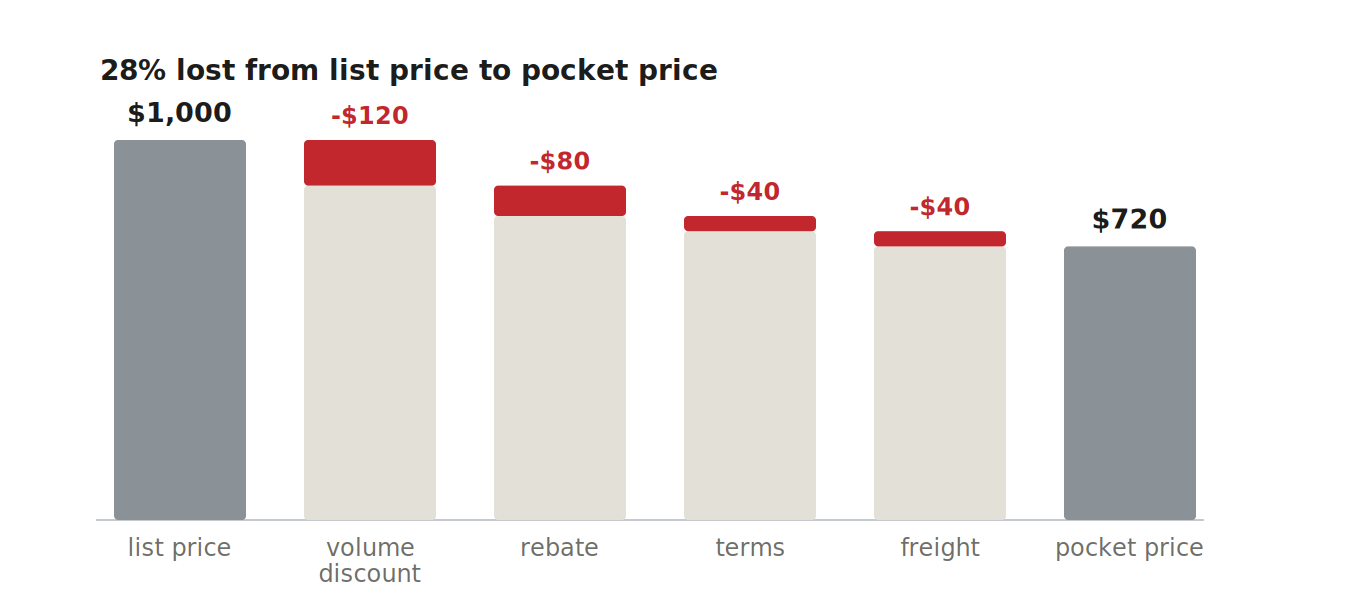
That gap has a name. The price waterfall is the cascade of deductions that turns a list price into the pocket price, the amount you truly keep after every discount and concession. In a typical B2B deal the waterfall includes:
- Volume and negotiated discounts taken off the list price.
- Off-invoice rebates and year-end incentives that never show up on the quote.
- Payment terms and early-pay discounts that quietly cost real money.
- Freight, onboarding, or services thrown in to close the deal.
Each step looks small in the room. Together they can erase a quarter or more of the list price, and because most of them sit off the invoice, no single person sees the full leak. That is revenue leakage in its most common form: not lost deals, but margin handed away inside deals you won.
Consider a mid-market industrial distributor, the kind of PE-backed business where pricing has grown up deal by deal. Its list price on a core product is $1,000. A volume discount takes $120, an off-invoice rebate another $80, extended payment terms cost the equivalent of $40, and freight thrown in to win the order costs $40 more. The pocket price is $720, a 28 percent gap from list. Worse, because reps grant these concessions on instinct rather than rule, one customer pays $720 while a similar one down the road pays $810 for the same product. Leadership sees a $1,000 list and a healthy gross margin; the real margin is leaking 280 dollars at a time, and nobody owns the gap.
Four levers that move price and margin
Once you can see the leak, optimization is about pulling a few specific levers in the right order. The first two protect margin; the last two grow revenue.
Bring discipline to discounting
The fastest margin win is usually not a price increase at all. It is discipline on the discounts you already give. Discount management means setting clear approval thresholds, floor prices below which a deal needs sign-off, and guidance that tells reps what good looks like before they negotiate. The goal is not to ban discounts. It is to make sure each one is earned, consistent, and visible. Strong pricing governance is what keeps the gains in place after the project ends, so the waterfall does not quietly refill over the next year.
Pricing & growth expertise
Expert-led pricing & growth strategy for growth-focused and PE-backed companies.
Enterprise-quality work. Practical recommendations. 6-10 week timelines.
Price for the value each customer gets
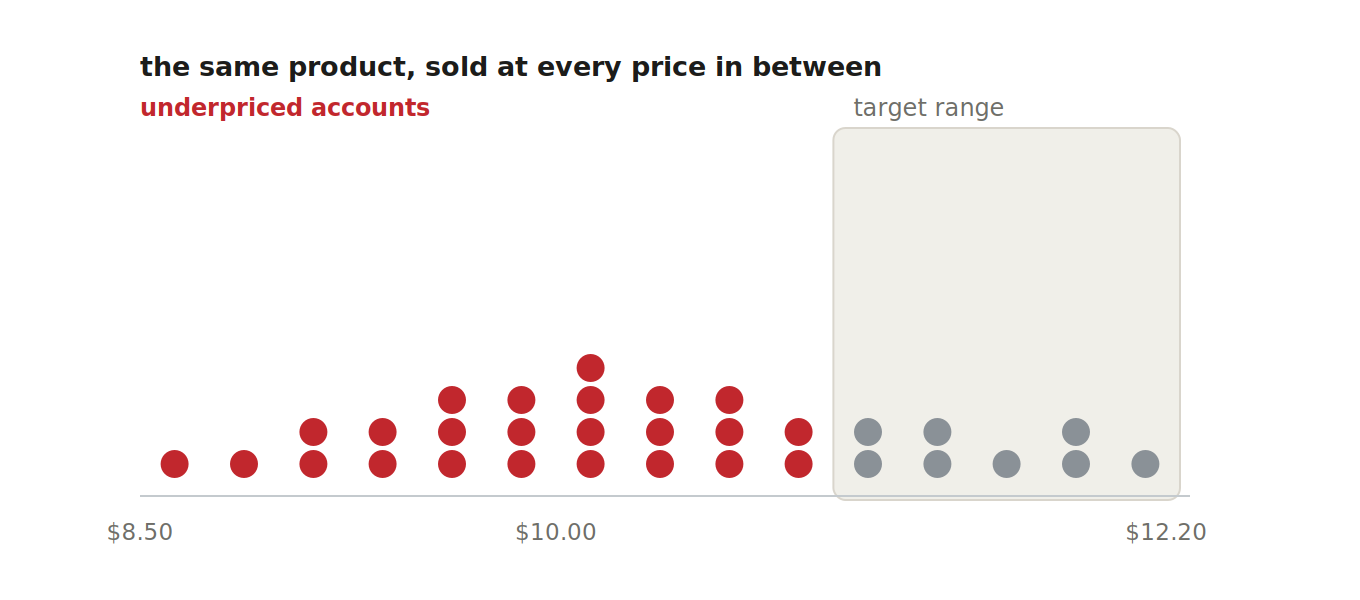
Flat, one-size pricing leaves money on the table at both ends. Price segmentation charges customers in line with the value they receive and the price they are willing to pay, using signals such as size, industry, usage, urgency, and strategic importance. The clearest symptom of missing segmentation is price dispersion: the same product selling across a wide band of prices with no logic behind it.
Take a manufacturer of engineered components selling one SKU across a few hundred accounts. Pull the transaction data and the price ranges from $8.50 to $12.20, with similar customers scattered across the whole range purely because of who negotiated hardest. Optimization sets a defensible floor, aligns price to segment, and pulls the low outliers up toward what comparable customers already pay. No new product, no new customer, just margin that was always available.
Collect the price you set
Price realization is the discipline of collecting the price you set. Realization work targets the waterfall directly: renegotiating the rebates that no longer drive behavior, repricing accounts that have drifted far below the norm, and tightening the terms that leak value off the invoice. Underpriced, long-tenured accounts are often the richest opportunity, because the cost to serve them has not changed even as their value has grown.
Let the data find the leaks
Optimization runs on evidence, not instinct. Pricing analytics turns transaction history into a clear picture of where prices are too low, which discounts actually win deals, and where margin is leaking by segment, product, and rep. Price optimization software can sustain that view in real time once the strategy and guardrails are set, though it is worth being clear that software amplifies a sound pricing strategy and cannot substitute for one.
A two-move example
The two jobs, protecting margin and growing revenue, are most powerful when they run together. The figures below are illustrative, but the sequence is typical.
Consider a PE-backed B2B software company doing about $30 million in revenue, where the average discount off list has crept to 22 percent through years of unmanaged deal-making. The work happens in two moves.
First, protect the margin already being earned. Deal governance, approval thresholds, and clear floor pricing bring the average discount from 22 percent down to 16 percent. That six-point improvement in realized price is almost pure profit, because the cost to serve those customers barely changes, so the recovered margin drops straight toward EBITDA.
Second, grow the revenue the model is leaving behind. A pricing diagnostic shows that a segment of small but heavy users sits well below their willingness to pay. A targeted, well-communicated increase lifts price for that group with no measurable churn, because the value was always there to support it.
For a PE-backed portfolio company, this combination is often the fastest lever in the value-creation plan. It expands margin and lifts revenue without the capital, time, or risk that a new product or an acquisition would demand, which is exactly why pricing tends to show up early in a serious value-creation agenda.
A sensible order of operations
Pricing optimization is less daunting when it follows a clear order. A practical sequence looks like this:
- Run a pricing diagnostic to map the waterfall and find where price and margin are actually leaking.
- Fix the leaks first, since tightening discounting and terms returns margin fastest and funds the rest of the work.
- Segment next, aligning price to the value different customers receive.
- Set guardrails and governance so the gains hold and discipline survives the next quarter.
- Monitor continuously, because markets, costs, and competitors keep moving and so should your prices.
The order matters. Companies that chase a headline price increase before fixing the waterfall usually watch the new margin leak straight back out.
Two results from one discipline
Pricing optimization earns its place at the top of the list because it works on both sides of the equation at once. Tightening the waterfall protects the margin you are already owed, and aligning price to value grows the revenue you have been leaving behind, with most of both gains flowing through to profit. It is not a single decision but a discipline, and for B2B companies under pressure to expand margin and grow revenue together, it is usually the lever that moves first and pays back soonest.
See what your pricing is really collecting
Most teams are surprised by the size of the gap between their list prices and what actually reaches the bottom line. Acustrategy works with B2B and PE-backed companies to size that gap, recover the margin hiding in the waterfall, and align price to the value each customer receives, with governance that makes the gains stick. If you want a clear read on where your pricing stands, book a working session with a B2B pricing consultant and we will walk through the numbers with you.
