

The hard part is setting the price. Realization is keeping it.
Price realization is the share of your list or target price that you actually collect once every discount, rebate, and concession has been taken out. It is the difference between the price you set and the price you keep, expressed as a percentage, and it is one of the most revealing numbers in a B2B business. A company can have disciplined list prices and still bleed margin if price realization is weak, because the erosion happens quietly, one approved exception at a time. Improving price realization is often the fastest margin available to a leadership team, since the price has already been set and the work is simply collecting more of it. This guide covers the definition, the formula, illustrative examples, and practical tips to improve it.
The gap between list and collected
Every B2B sale starts from a list or target price and ends at a different, lower number. Between the two sits a series of deductions: negotiated discounts, off-invoice rebates, payment terms, freight, and one-off concessions granted to close the deal. The price waterfall is the name for that cascade, and the amount left at the bottom is the pocket price, the revenue you truly keep. Price realization measures how much of the original price survives that fall.
The reason it matters is that the gap is mostly invisible. Leadership sees the list price and the top-line revenue, but rarely the deal-by-deal erosion in between. That is where revenue leakage hides, and why two companies with identical list prices can earn very different margins. One collects most of what it sets; the other gives a quarter of it away without anyone deciding to.
How to calculate price realization
The formula is simple. At the level of a single deal:
Price realization rate = realized price divided by list price, expressed as a percentage.
Across a whole book of business, the same idea scales up: total net revenue divided by what that revenue would have been at full list price. A realization rate of 100 percent means you collect every dollar you set. A rate of 80 percent means a fifth of your pricing disappears between the quote and the bank.
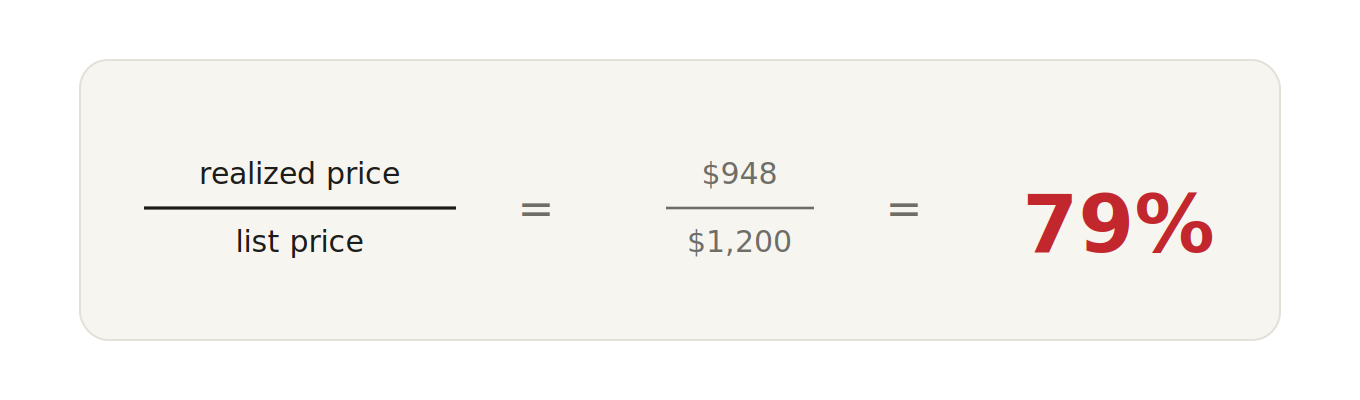
Consider a commercial lighting manufacturer with a list price of $1,200 on a core fixture. After a volume discount, an off-invoice rebate, and freight thrown in to win the order, the realized price lands at $948. Its price realization on that deal is $948 divided by $1,200, or 79 percent. The list price was never the issue; the 21-point gap between list and pocket is the whole story, and it is the number worth managing.
The same math at the portfolio level is where it gets serious. If that manufacturer books $50 million in revenue at an average realization of 79 percent, it is leaving roughly $13 million of set price uncollected against full list. Lifting realization by even three points is worth about $1.9 million, and because the cost to serve does not move, nearly all of it reaches the bottom line.
What strong and weak realization look like
A single realization rate is useful, but the real insight comes from breaking it apart. Realization almost always varies more across a business than its leaders expect, and the variation points straight at the opportunity.
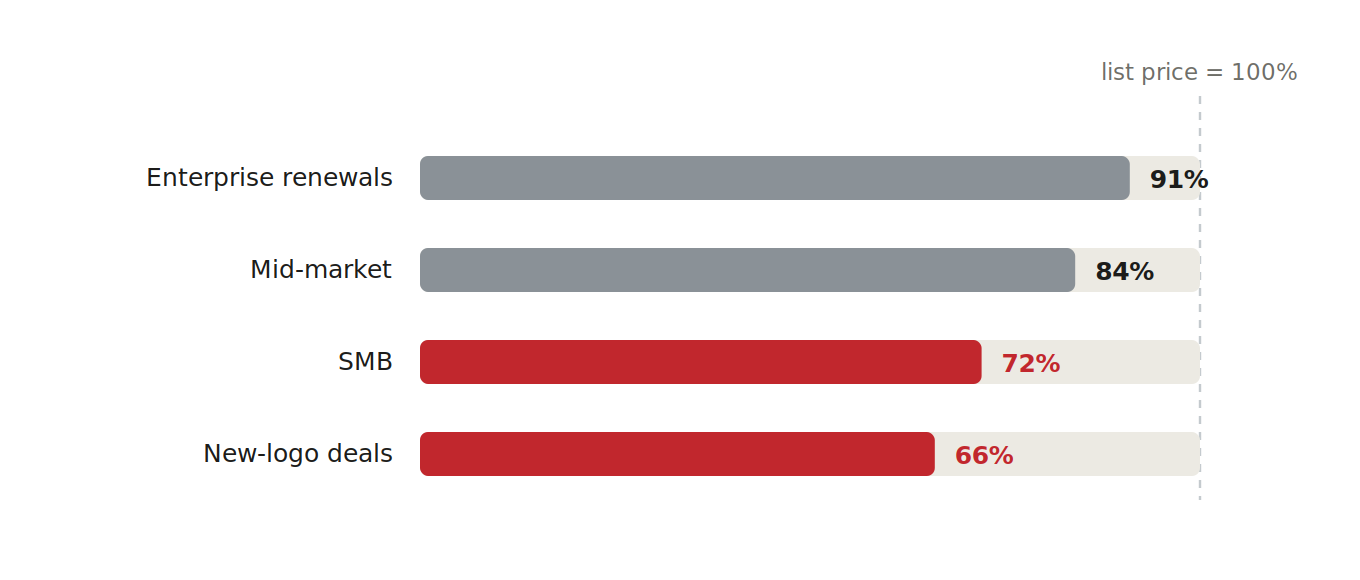
Take a fleet-maintenance software company that measured realization by customer segment for the first time. On enterprise renewals it collected 91 percent of list, but on new-logo deals it collected just 66 percent, because reps discounted aggressively to win logos and the concessions were never unwound at renewal. Mid-market and SMB sat in between. The average looked acceptable; the spread did not. By putting a floor price on new-logo deals and a clear path to step them up at renewal, the company lifted that segment toward 76 percent within two quarters, without losing deals it should have won.
That pattern, healthy realization in one segment and a quiet leak in another, is the rule rather than the exception. You cannot fix what you have not separated.
Pricing & growth expertise
Expert-led pricing & growth strategy for growth-focused and PE-backed companies.
Enterprise-quality work. Practical recommendations. 6-10 week timelines.
How to improve price realization
Improving realization is less about raising prices and more about keeping the prices you already set. A few moves do most of the work.
Map the realization gap first
You cannot manage a number you cannot see. The first step is to calculate realization by segment, product, region, and rep, so the leaks become specific rather than abstract. Most of the data already sits in your invoices and CRM; pricing analytics turns it into a clear view of where realization is strong and where it falls away.
Put guardrails on discounts and terms
Most realization leaks through discounting that no one is governing. Clear floor prices, approval thresholds above a certain discount, and visibility into off-invoice terms turn discounting from a reflex into a decision. Good discount management does not ban concessions; it makes sure each one is earned and accounted for.
Reprice the accounts that have drifted
Long-tenured accounts are often the worst offenders, because small annual concessions compound. A metal-fabrication supplier found that annual loyalty discounts had been stacking on top of standing volume discounts for years; capping the stack recovered about four points of realization across the book, with almost no customer loss because each account was still being treated fairly relative to its peers.
Make realization a number someone owns
Realization erodes when it is nobody’s job. The companies that hold their gains put realization on a dashboard, review it on a regular cadence, and give a specific owner responsibility for it, supported by clear pricing governance. What gets measured and owned stops drifting.
The cheapest growth you have
Price realization rewards attention more than almost any other pricing lever, because the value is already in your contracts; you are simply collecting more of it. Closing even a few points of the gap between list and pocket flows almost entirely to margin, since the cost to serve does not change, which makes it one of the most direct ways to reverse margin erosion. For B2B companies under pressure to protect margin without raising headline prices or risking volume, realization is usually the first place to look and the cheapest growth available.
You already set the price, now keep it
The hard part, deciding what your product is worth and putting a number on it, is already done. The opportunity is in how much of that number actually reaches you. Acustrategy helps B2B and PE-backed companies measure price realization across their book, find where it leaks, and put the guardrails and ownership in place to close the gap for good. If you want to know how much of your pricing you are really collecting, talk to a B2B pricing consultant and we will help you find out.
