

A price that looked healthy last year has probably drifted since. The trend is the thing to watch.
Pricing performance is how well your pricing is doing its job, capturing value and protecting margin, measured not once but continuously as it changes.
Tracking pricing performance over time matters because pricing rarely fails all at once. It erodes quietly, one approved discount and one un-repriced renewal at a time, so a number that looked healthy at last year’s review can slip several points before anyone notices.
The companies that hold their pricing gains are the ones that watch a handful of pricing performance metrics on a regular cadence and act on the trend, not the annual snapshot.
This guide explains what to track, how to set the tracking up, and how to turn the trend into decisions.
Pricing performance is a trend, not a snapshot
A single reading tells you where you are; a trend tells you where you are heading, which is the more useful thing to know. Realized price of 88 percent looks fine on its own.
Realized price that has fallen from 92 to 88 over three quarters is a warning, and the two look identical in a point-in-time report. This is the core reason to track pricing performance over time rather than checking it when the annual plan comes due.
The erosion is gradual by nature. Each individual concession seems reasonable in the room, and none of them shows up as a problem on its own. Only the trend line reveals the pattern, and only if someone is watching it. Catching a two-point slide in month three is a quick conversation; discovering an eight-point slide at year end is a painful project.
The signals worth watching over time
You do not need a wall of dashboards. A few metrics, tracked consistently, capture most of what matters.
- Realized price: the clearest single measure of whether pricing is holding, since it captures the share of list price you actually collect after every deduction.
- Average discount: the depth of discounting you give away on a typical deal, and the first place erosion shows up.
- Price dispersion: how widely the same product’s price varies across similar customers, which widens as discipline slips.
- Margin by segment or product line: where profit is quietly eroding once cost to serve is included; break it out by customer segment to see the leak.
- Win rate by price: whether your close rate is moving as prices change, which signals how much room you have.
- Price attainment against plan: how actual realized price compares to the target you set for the period.
Consider a building-products distributor that began tracking gross margin by product line each quarter. One line looked stable in the annual numbers, but the quarterly trend showed margin sliding about three points over the year as small freight concessions crept into more and more orders. The annual view had averaged the slide into invisibility; the trend made it obvious, and the fix was a single change to freight terms.
Set up the tracking
Tracking pricing performance is less about tools than about a simple, repeatable discipline. Four steps put it in place.
Baseline first, then watch the trend
You cannot see drift without a starting point. Establish the current level of each metric, by segment where it matters, so every later reading is measured against a known baseline rather than a vague sense of how things used to be.
Pick a cadence and hold it
Pricing performance should be reviewed on a fixed rhythm, monthly for fast-moving metrics like discounting, quarterly for slower ones like margin by line. The cadence matters more than the frequency; a metric looked at reliably every quarter beats one checked intensely once and then forgotten.
Set thresholds that trigger action
A trend is only useful if you decide in advance what level demands a response. Setting a target and an acceptable range around it turns monitoring into management: as long as realized price stays in the band, you leave it alone, and when it breaks below, that triggers a specific review rather than a shrug.
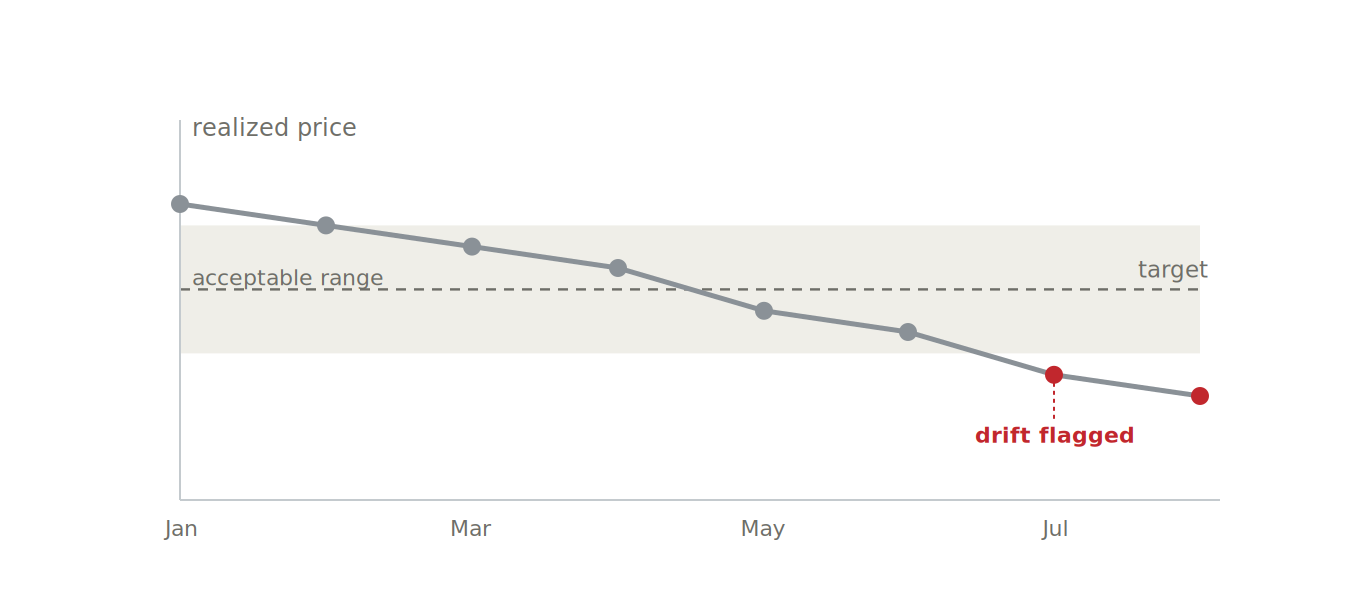
Consider a commercial insurance software provider that put realized price on a monthly dashboard with a target of 90 percent and an acceptable floor of 87.
When the number slipped below the floor two months running, driven by reps leaning harder on end-of-quarter discounts, the breach triggered a review while the slide was still small. Tightening discount approvals brought it back within a quarter.
Without the threshold, the same erosion would have surfaced only at the annual review, several points deeper.
Put one person in charge of the trend
Metrics that belong to everyone belong to no one. A named owner, supported by clear pricing governance, is what keeps the review happening and the drift getting addressed instead of noted and forgotten.
Turn trends into decisions
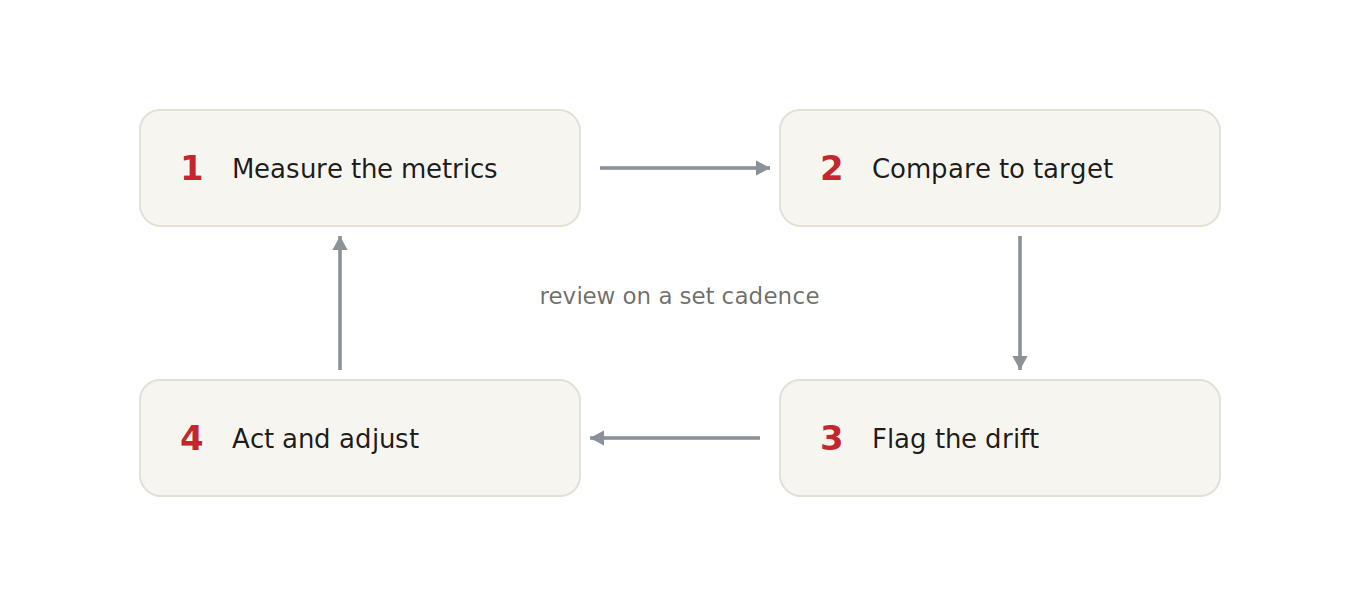
Tracking earns its keep only when it changes what you do. The point of watching the trend is to close a loop: measure the metrics, compare them to the target, flag the ones that have drifted, and act, then measure again.
Run that cycle on a cadence and pricing performance stops being something you discover once a year and becomes something you manage continuously.
Acting does not always mean a price change. A falling win rate by price might call for better sales enablement rather than a lower price. Rising dispersion might call for tighter discount guardrails.
A lab-instruments maker that watched win rate by price band, for example, saw the rate on one segment fall steadily over several months; the trend was an early signal that a competitor had moved, and the response was a targeted repositioning rather than an across-the-board cut.
The trend told them something was wrong; the diagnosis told them what to do.
What gets watched gets protected
Pricing performance responds to attention. The gains from a pricing project fade without monitoring, because the same pressures that eroded pricing the first time never went away.
A small set of metrics, a fixed cadence, clear thresholds, and a named owner are enough to keep the trend visible and the erosion in check. It is far cheaper to defend good pricing a few points at a time than to rebuild it once a year.
When did you last look at your pricing trend?
If the honest answer is the last annual review, your pricing has probably drifted since, and you cannot see by how much.
Acustrategy helps B2B and PE-backed companies decide which pricing performance metrics to track, set the targets and cadence, and stand up the monitoring that keeps the gains in place, with our PricePro software keeping the trend live between reviews.
If you want a clear, current view of how your pricing is performing, book a working session and we will build it with you.
