

Price is a number. A monetization strategy is the structure that number lives inside.
A monetization strategy is the plan for how a business turns the value it creates into revenue: what it charges for, how it packages that charge, and how the money grows as customers grow. It is a wider decision than price. Price is a number; a monetization strategy decides the whole structure that number lives inside, and that structure sets the ceiling on how much a company can earn from a given product. For B2B companies, especially PE-backed ones looking for durable revenue growth, getting the monetization strategy right is often worth more than any individual price change. This guide covers the main types, real examples of each, and the best practices that separate a model that scales from one that quietly caps you.
How value becomes revenue
Most pricing conversations start too late, at the level of the number on the quote. A monetization strategy starts earlier, with a simpler question: what exactly are we selling, and what should the meter run on? The answer shapes everything downstream. A company that meters on users will grow differently from one that meters on usage, even if both sell the identical product at the identical headline price.
That is why monetization sits above pricing. Pricing sets the level. Packaging decides how features and tiers are grouped. The monetization model decides what the customer is actually buying a unit of, and how more value turns into more revenue over time. Get that unit right and the rest of pricing becomes far easier. Get it wrong and no amount of discounting discipline or clever packaging will fix it.
The main types of monetization strategy
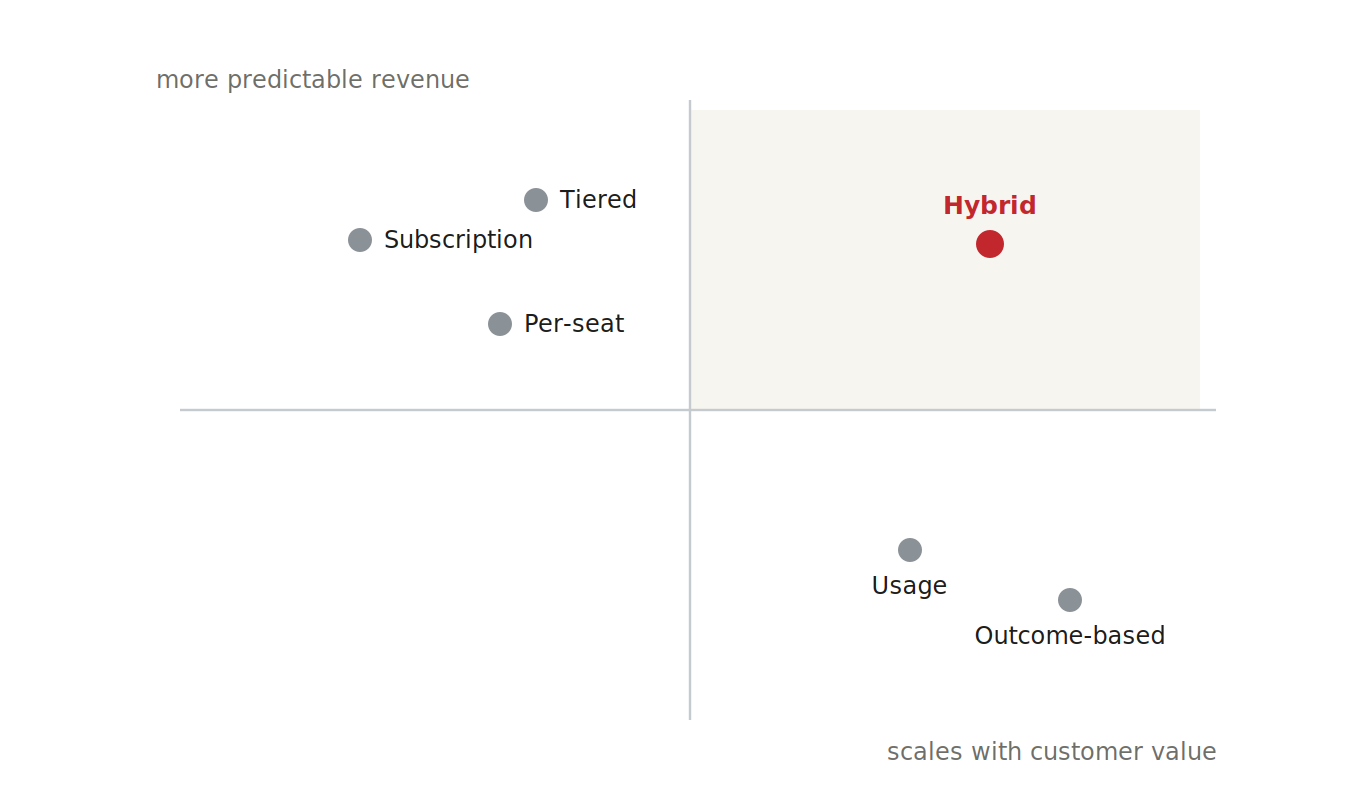
Most monetization strategies are built from a handful of recognizable models, often in combination. The right one depends on how your customers get value and how predictable you need revenue to be.
- Subscription: a recurring fee for ongoing access, billed monthly or annually. Predictable for both sides, but blind to how much value the customer draws unless paired with another lever.
- Per-seat: revenue scales with the number of users. Easy to forecast and sell, but it caps growth when value does not actually track headcount.
- Usage-based: customers pay for what they consume, such as transactions, volume, or compute. Revenue follows value closely, at the cost of some predictability.
- Tiered and good-better-best: features and limits are packaged into named levels, guiding buyers to the right fit and creating a built-in path to upgrade.
- Value or outcome-based: the charge is tied to a result the customer cares about, such as savings delivered or revenue generated. The strongest alignment, and the hardest to design and measure.
- Hybrid: a platform or base fee combined with a usage or outcome component. This pairs predictable baseline revenue with upside that scales as the customer grows, which is why so many durable B2B models land here.
No single model is best in the abstract. Each trades predictability against how tightly revenue tracks the value a customer receives.
Monetization in practice
The clearest way to understand these models is to see what changes when a company picks one over another. The examples below are illustrative, but the patterns are common.
From a flat fee to usage
Consider a company that sells a document-verification API to other businesses. It originally charged a flat $60,000 annual license, the same fee whether a customer ran a thousand verifications a month or a million. Heavy users were a bargain and light users overpaid, so the company won the wrong deals and left money on the table with the right ones. Switching to usage-based pricing at $0.50 per verification changed the economics. A customer running 30,000 verifications a month now pays about $180,000 a year, three times the old flat fee, while a small customer pays a fair amount that actually wins the deal. Revenue began to track the value each customer drew from the product, automatically, with no renegotiation.
Layering expansion onto a subscription
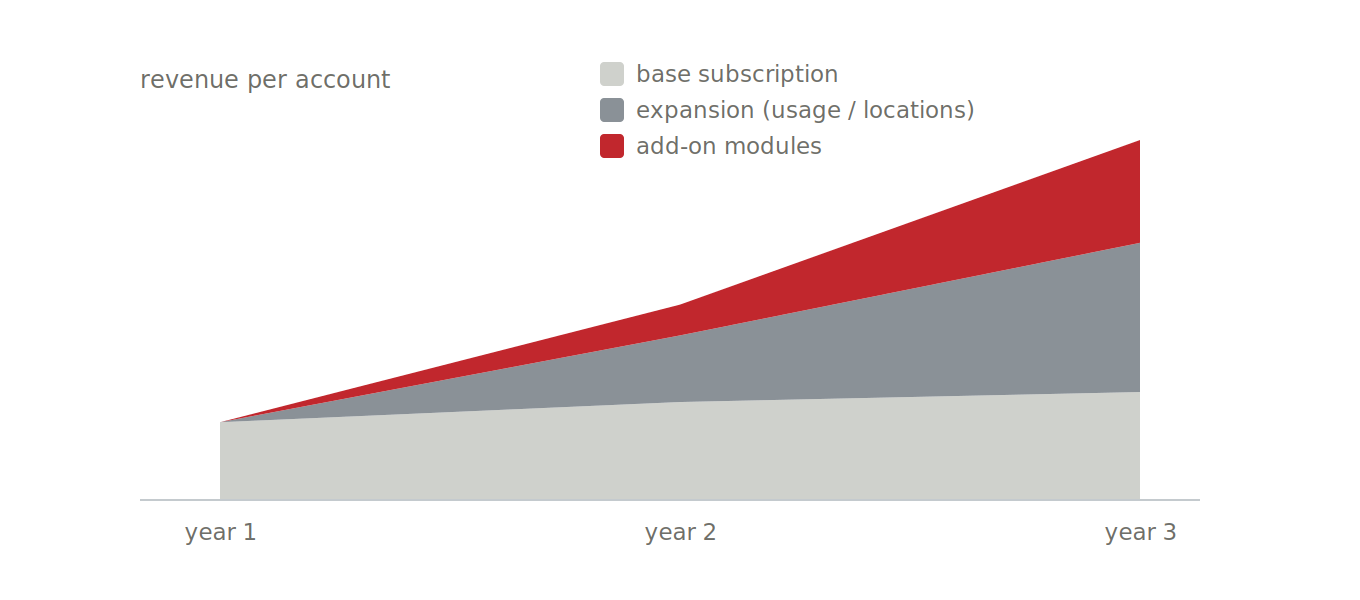
A monetization strategy is rarely one charge. The strongest B2B models land a customer with one model and expand with another. Take a facilities-management software platform that lands new customers on a base subscription, then grows the account as the customer adds locations and turns on a usage-metered analytics module. A single account might start at around $24,000 a year on the base platform and reach $120,000 within three years, with most of the growth coming from expansion and add-ons rather than the initial subscription. The first sale is just the entry point; the monetization strategy is what compounds after it.
Monetizing on outcomes
The most aligned models charge for the result. An industrial energy-optimization vendor, for instance, can charge a share of the energy savings it verifiably delivers, say 20 percent of audited annual savings. A plant that saves $500,000 a year generates $100,000 for the vendor, and the customer pays only out of money it would not have had otherwise. The model is hard to build, because it depends on measuring the outcome credibly, but when it works the alignment is almost total: the vendor earns more precisely when the customer wins more.
Pricing & growth expertise
Expert-led pricing & growth strategy for growth-focused and PE-backed companies.
Enterprise-quality work. Practical recommendations. 6-10 week timelines.
Best practices for a monetization strategy
Whatever model you choose, a few principles separate the ones that scale from the ones that stall.
Start from how customers get value
The single most important decision is what the meter runs on, and the only good answer comes from how the customer actually derives value, and what their willingness to pay is tied to. If value grows with usage, meter on usage. If it grows with the number of people, meter on seats. If it grows with an outcome, find a way to meter on that. A model that charges for something disconnected from value will always fight the customer rather than grow with them.
Let the account grow without a renegotiation
The best monetization strategies expand on their own as the customer succeeds. A model that only grows when a salesperson reopens the contract puts a hard ceiling on net revenue retention. A model tied to the customer’s own growth, through usage, locations, or outcomes, expands quietly in the background, which is the difference between chasing every increase and earning it automatically.
Keep packaging simple enough to buy
Alignment is worth nothing if buyers cannot understand what they are paying for. A monetization model that takes a spreadsheet to explain will slow deals and breed mistrust. The goal is a structure a buyer can grasp in a single conversation, with a clear reason that price rises as they get more value. Getting pricing and packaging to work together is what makes a model both aligned and sellable.
Treat the model as a living decision
Monetization is not set once at launch. Products gain new capabilities, markets shift, and a model that fit the first version of the product can quietly cap the third. The discipline is to revisit how you monetize on a regular cadence, and to be willing to change the meter when the way customers get value has changed.
Choose the model your value is asking for
A monetization strategy is one of the highest-leverage choices a B2B company makes, because it decides not just what you earn today but how that revenue grows for years. The types are well understood; the skill is matching one, or a deliberate combination, to how your customers actually get value, and then keeping it simple enough to buy and current enough to keep working. The companies that monetize best are not charging the most. They are charging in the way their value asks them to.
Your best growth lever might be how you charge
It is easy to treat the monetization model as a settled question and pour energy into discounts and promotions instead. Often the larger opportunity is in the structure itself: charging for the right unit, in a way that grows with the customer. Acustrategy helps B2B and PE-backed companies pick and design the monetization model that fits the value they create, and build a realistic path to move toward it. If you suspect your model is leaving growth on the table, talk to a pricing strategy consultant and we will help you find the structure your value is asking for.
