

One price for a mixed customer base is always wrong for most of them.
Pricing segmentation is the practice of charging different prices, or offering different packages, to different groups of customers based on the value they receive and what they are willing to pay.
A single price for a diverse customer base is always a compromise: it is too high for the price-sensitive buyers you then lose, and too low for the high-value buyers who would happily have paid more.
Pricing segmentation resolves that compromise by matching price to value, one group at a time. For B2B companies with a wide range of customers, it is one of the most reliable ways to grow revenue and margin at once, without changing the product.
This guide covers the main types, worked examples, and the strategic benefits.
Why one price never fits everyone
Different customers get different amounts of value from the same product, so a single price can only ever be right for a slice of them.
Charge at the level a small buyer can afford and you give the product away to large buyers who would have paid far more. Charge at the level a large buyer will bear and you price the smaller ones out entirely. Either way, revenue is left on the table at one end or the other.
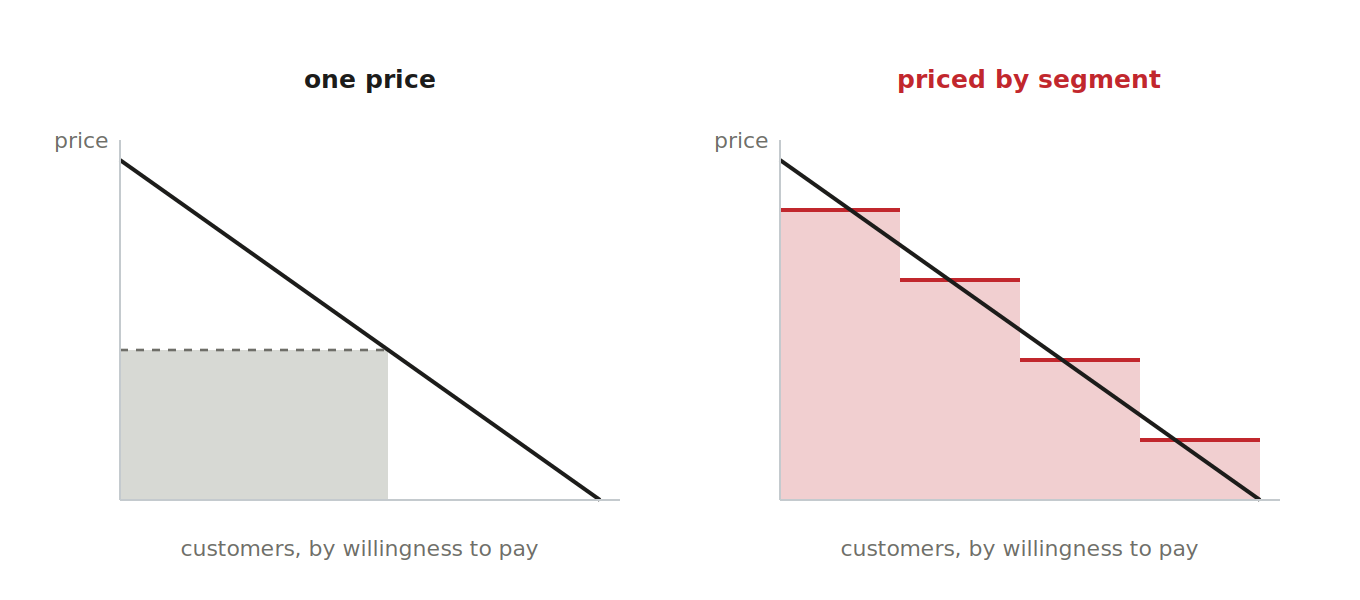
The reason is that willingness to pay is spread across a range, not fixed at a point.
One price captures only the value directly beneath it. Segmentation captures more of that range by setting several prices, each closer to what a particular group actually values the product at.
The same logic underpins value-based pricing; segmentation is how you apply it across a real customer base rather than a single ideal customer.
The bases you can segment on
Segmentation works by finding a characteristic that both correlates with value and can be used to set price fairly. A handful of bases do most of the work in B2B.
- By customer size: larger customers usually derive more value and have more budget, which is why enterprise pricing sits well above SMB pricing for the same core product.
- By industry: the same product can be worth far more in one vertical than another, depending on how central it is to that industry’s outcomes.
- By geography: willingness to pay, competition, and cost to serve vary by region, so a single global price rarely fits.
- By channel: direct, partner, and marketplace sales carry different costs and buyer expectations.
- By use case: a customer using a product for a mission-critical purpose values it differently from one using it casually.
- By willingness to pay directly: measured through price sensitivity analysis and research, when a cleaner proxy is not available.
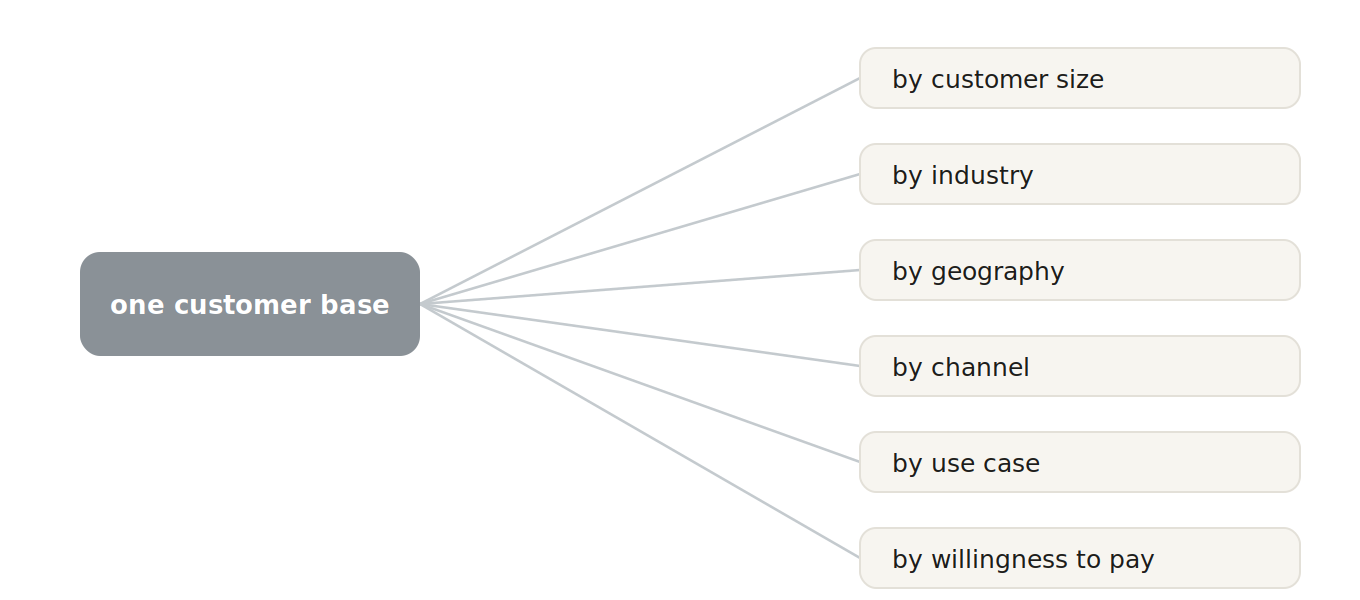
The best segmentation usually combines two or three of these, such as size within industry, rather than relying on one alone.
Pricing segmentation in practice
The examples below are illustrative, but the patterns are common across B2B.
Segmenting by customer size
Consider a B2B cybersecurity software company charging a flat $80 per seat per month to every customer.
Small firms found that steep against tight budgets, so the company lost deals it should have won at the bottom of the market. Large enterprises, meanwhile, were getting enormous value, since the software reduced a risk that could cost them millions, and $80 a seat was almost nothing to them.
By segmenting into an SMB tier at $50 per seat and an enterprise tier at $110 per seat with the controls large buyers needed, the company won more small accounts and captured far more from large ones.
The product did not change; the pricing finally matched the value each group received.
Segmenting by industry
A manufacturer of industrial adhesives sold the same structural bonding product at $18 a liter to everyone. To a furniture maker it was one input among many. To an aerospace supplier, where certified performance was critical and alternatives were few, it was worth far more.
The manufacturer created an aerospace-grade offer at $34 a liter, with the certification and support that segment needed. That captured the value a single price had been ignoring, while the furniture segment stayed untouched.
Keeping segments apart with fences
Segmentation only holds if a low-price segment cannot quietly buy at its rate and resell into a high-price one. That is the job of price fencing: rules that keep the segments separate.
A geospatial data provider, for instance, can segment by use case, charging one rate for internal analytics and a higher one for embedding the data into a product the customer resells.
The fence is the license term itself, which permits one use and prohibits the other.
Without a credible fence, the higher-value segment simply migrates to the lower price and the segmentation collapses.
The strategic benefits of pricing segmentation
Done well, segmentation pays off in several ways at once.
- Captured willingness to pay: high-value customers pay closer to what the product is worth to them, instead of the average.
- More deals at the low end: a lower, well-fenced tier wins price-sensitive buyers you would otherwise lose, without discounting for everyone.
- Protected margin: because you are raising price only where value supports it, margin expands without a blanket increase that risks volume.
- Better product fit: segment tiers double as packaging, guiding each group to the version built for it.
- Defensible, fairer pricing: prices tied to clear differences in value are easier for sales to hold and for customers to accept.
For a PE-backed portfolio company, segmentation is a particularly efficient lever, because it grows revenue from the existing customer base and product, with no new build required.
Where segmentation goes wrong
The two common failure modes are opposite. Segmenting on the wrong basis, one that does not actually track value, produces prices customers see as arbitrary and resist.
Over-segmenting, with too many tiers and rules, creates a structure nobody can explain or buy. The discipline is to segment on a basis that genuinely correlates with value, keep the number of segments small, and fence them clearly.
Analytics helps here: pricing analytics on your own transaction data will usually show where value and price have drifted apart, and which segments are worth separating.
Match price to value, group by group
Pricing segmentation is one of the highest-return pricing moves available, precisely because it works with the customers and product you already have.
The skill is in choosing a basis that tracks value, setting a small number of clear segments, and fencing them so each holds.
Get that right and you stop losing the price-sensitive deals at one end while finally capturing the value you have been giving away at the other.
Are you charging one price for very different value?
If a single price is doing the work across customers who value your product very differently, you are almost certainly losing revenue at both ends of the range.
Acustrategy helps B2B and PE-backed companies find the segmentation that fits their customer base, set the tiers and fences, and roll it out without disrupting the accounts they already have.
If you want to see where one price is costing you, talk to a pricing strategy consultant and we will map it with you.
