
Pricing and revenue management
built to work as one system

Where pricing and revenue management pull apart
Pricing and revenue management are usually run as two separate jobs, and that is exactly where money goes missing. One team sets the price. Another scrambles to hit the number at quarter end. The price list says one thing, the closed deals say another, and no one owns the distance between them. Looked at on their own, each function seems to be doing fine. Put side by side, the gaps are hard to miss.
How our pricing and revenue management works

We run them as one loop, not two functions
Pricing sets the intended number and revenue management protects it through to the deal. We connect the two so they inform each other rather than operate in separate spreadsheets and separate meetings.

We set prices the business can actually hold
A price is only useful if it survives a negotiation. We ground pricing in evidence and a clear pricing and packaging strategy, so the number is defensible long before a rep has to defend it.

We manage the gap between list and realized
Most of the leakage lives in discounts, exceptions, and renewals. We put rules and approvals around those moments so realized revenue tracks the prices you intended, not the ones sales improvised.

We read it in margin, retention, and mix
Pricing and revenue management only count when they land in the numbers. We connect each change to gross margin, net revenue retention, and deal mix, so leadership sees what moved and why.

We close the loop with deal data
What happens in live deals becomes the input for the next pricing round. The cycle tightens over time instead of resetting from scratch every planning season.
The pricing and revenue management
What pricing and revenue management covers
- Price setting and price realization treated as one connected practice, not two projects
- Discount governance, approvals, and renewal pricing brought under shared rules
- Segmentation and packaging matched to how each part of the base actually buys
- A clear line from every decision to margin, retention, and revenue mix
Who sits at the table
- Senior operators who have set prices and owned the number, not a junior project team
- Direct work with your pricing, finance, sales, and revenue leaders
- Experience across SaaS, services, and manufacturing revenue models
- Recommendations that hold up with the board and on the sales floor alike
How we keep it usable
- Scope kept tight so the loop starts turning in weeks, not quarters
- The systems and data you already run put to work through price management software, not replaced
- Decision rights written down so pricing and revenue ownership is never blurred
- Progress read in realized outcomes, not slides produced
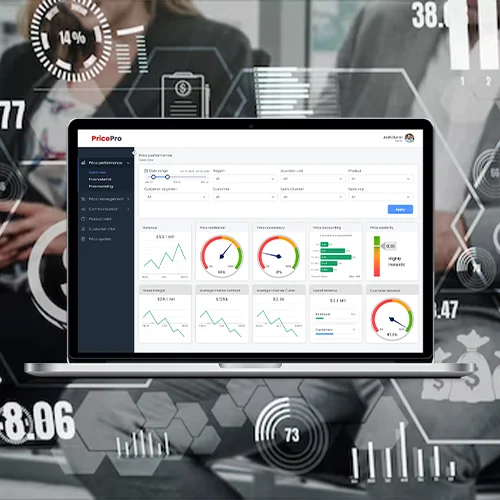
How PricePro connects pricing and revenue management
• Puts the intended price and discount guidance in front of the deal as it happens
• Keeps pricing, margin, and realization data in one controlled place
• Connects to the CRM and ERP systems your teams already run
• Applies pricing and approval rules at the point of quote
• Shows leadership where realized revenue is drifting from intended price
• Feeds deal outcomes back into the next round of pricing decisions

What we usually find first
Our pricing and revenue management approach
We establish what each segment should pay and why, grounding the number in evidence so it can stand up under pressure rather than bending at the first objection.
We put discount rules, approval paths, and renewal logic in place so the price you set is the price that survives the negotiation and the renewal.
Realized prices, discount patterns, and win rates flow back into pricing, so each cycle is sharper than the last instead of starting from guesswork.
Review cadences and clear ownership keep the loop turning, and let both halves flex as cost, competition, and the portfolio thesis change.
Managing them separately versus as one system
Pricing and revenue managed apart
• Prices set in isolation, then quietly eroded in the field
• Revenue chased at quarter end with discounts nobody planned
• Last quarter’s deal data left unused when the next price is set
• Finance and sales arguing over a gap neither one owns
• Good pricing and missed targets sitting side by side

Pricing and revenue managed as one
• A price that is set with realization already in mind
• Discounts and renewals governed so the number holds
• Deal outcomes feeding directly into the next pricing round
• Clear ownership across pricing, finance, and sales
• Intended price and realized revenue moving closer together

FAQ
Pricing decides the number a customer should pay. Revenue management makes sure that number survives discounts, exceptions, and renewals to become realized revenue. Run together, they form one loop instead of two disconnected jobs.
Because they fail apart. Strong pricing leaks away without realization discipline, and revenue management without sound pricing is just firefighting. Connecting them is what turns a good price list into revenue you actually keep.
Discounts, approvals, and renewals stop being improvised. Reps get clear room to negotiate and clear limits, and the prices that get quoted line up with the prices leadership intended.
Realized prices, discount patterns, and win rates from closed deals become the evidence for the next pricing round. Instead of resetting each planning cycle, pricing gets sharper with every quarter of data.
No. We work inside the CRM, ERP, and pricing tools you already run, adding the rules, visibility, and governance that let pricing and revenue management operate as one.
Discounting behavior usually shifts within weeks of new rules going live. The gap between intended price and realized revenue narrows steadily as the loop starts turning.
No. The approach is built for mid-market organizations with lean teams. We simplify the decisions, assign ownership, and lend senior support so both halves run on the people you already have.
Through governance and measurement. Clear decision rights, review cadences, and PricePro keep pricing and realization aligned as products, markets, and the portfolio change.

