
Every price sits on an earlier choice about what the customer is paying for. We help leadership teams make that choice deliberately, for a new product, an AI capability, a service that has always been given away, or a business model that no longer earns what it should.


Pricing answers “how much”. Monetization strategy answers three questions that come before it: what do we charge for, how do we charge for it, and who pays. A company can have well-researched prices and still leave most of its value uncaptured, because it charges for the wrong thing, in the wrong rhythm, to the wrong budget holder.
The symptoms are recognizable. Revenue grows only when the customer buys more of the physical product, while the service, data, or expertise around it is given away. Customers who get ten times more value pay the same as those who barely use the offer. A new capability ships, everybody likes it, and nobody can say what it added to revenue. Each of these is a monetization problem, not a price problem, and changing the price level will not fix it.
The glossary entry on monetization strategy gives the short definition. This page is about how the decision is made in practice.
Every monetization model is a combination of three choices. Laying them out as a matrix makes the options visible, including the ones a company has never considered because its industry does not use them.
| What you charge for | How you charge | Who pays | Example |
|---|---|---|---|
| Access to a product | One-time purchase | The user’s company | Equipment sold outright |
| Capacity or entitlement | Subscription | The budget holder for that capacity | Software plans sized by team or site |
| Consumption | Pay per use or metered | The team that consumes | Cloud services, transaction fees |
| An outcome | Success fee or share of value | The executive who owns the result | Payment on cost saved or revenue gained |
| A service level | Contract or membership | Operations or procurement | Guaranteed response times, priority support |
| Data or insight | Subscription or per report | Analytics or strategy teams | Benchmarks drawn from aggregated activity |
| A complementary item | Captive or attached pricing | The existing customer | Consumables, parts, add-on modules |
Two patterns come out of this exercise again and again. First, most companies monetize only the first or second row and give away what sits lower down: the service commitment, the data, the expertise of their people. Second, the “who pays” column is where hidden headroom often sits. A capability that saves the finance team money is priced very differently when it is sold to the CFO than when it is bundled into a plan bought by an operations manager.
The most expensive monetization mistake is discovering after launch that customers value a new capability but will not pay for it. The fix is to make monetization part of the product decision, not something added once the engineering is done. Before development resources are committed, we work through this checklist with product, sales, and finance together.
Name the job the capability does. One sentence, in the customer’s terms, not a feature description. If the team cannot write it, stop there.
Identify who values it most. Which segment, which role, and how often they face the problem. A rare problem supports a one-off fee, not a subscription.
Quantify what it is worth to them. Time saved, cost avoided, revenue gained, or risk reduced, as a range with the assumptions stated.
Decide the monetization route. Included in existing offers to defend price, sold as an add-on, sold as a new product, or priced on usage or outcome.
Test willingness to pay before building. Structured interviews or a conjoint study with target buyers, using a description of the capability and a price range.
Check what it costs to serve. Variable costs such as compute, support, or materials set a floor below which the route chosen in step four stops making money.
Agree the launch measure. Attach rate, incremental revenue per account, or retention of the segment it was built for, with the target set before launch.
A capability that fails step three or step five may still be worth building to protect the core offer. The point of the checklist is that the choice is made knowingly, with the revenue expectation written down.
A monetization change can move revenue far more than a price change, because it alters how often and for how long a customer pays. A simple comparison shows the scale.
One-off visits, three years
Preventive plan, three years
A service business charges $300 per visit, and the average customer books 1.4 visits over three years: $420 of revenue per customer. The same business offers a preventive plan at $35 a month, $420 a year, and 20% of plan customers cancel each year. Over three years a plan customer is expected to pay $420 in the first year, $336 in the second, and $268.80 in the third: $1,024.80 in total, about 2.4 times the one-off customer.
The same arithmetic runs in reverse for a business considering the opposite move. A software company selling annual subscriptions to customers who use the product for a few weeks a year may earn more, and lose fewer customers, with a usage or project price, because the subscription is being canceled by the customers who feel they pay for idle months. The direction of the move depends on how the customer experiences value over time: continuously, in bursts, or once.
The comparison is only half the analysis. The plan has to cost less to deliver per customer than the value it adds, and it has to attract customers who would otherwise have booked a visit, rather than cannibalize the ones who would have paid more. Those are the questions a monetization design has to answer with data, not assume.
Each example comes from our published, anonymized case studies, with results as the client reported them. The first two are consumer services businesses; the logic of the shift is the same in B2B.
Changing when the customer pays.
A pest control company earned most of its revenue from one-off call-outs, and few customers came back. The finding that justified a new model was duration: households on a preventive plan stayed two to three times as long as those who called with a problem. Recurring plans became the main offer. Within 12 months, plan churn fell from 32% to 19%, uptake of plans was 28% higher, and average household revenue rose 18%.
Turning one-off visits into a relationship.
A growing chain of IV therapy clinics, expanding into new metros, sold individual treatments with little reason to return, and its bundles confused customers. Three-tier memberships gave regular customers a standing arrangement, with right-priced single treatments alongside. A standardized menu lifted average revenue per visit by 15%, attachment rates rose 20%, and churn went from 28% to 18%.
Charging for value clients were not being asked to pay for.
A subscription business in business and financial services discovered two things in its research: clients did not know most of what it offered, and many wanted analytics it could provide but had never sold. The recommendation was to make the whole range visible through value-based tiers, so that services clients had been missing could finally carry a price.
These are the principles we apply in every monetization strategy consulting engagement. Each one exists because its absence is a pattern we keep meeting.
A model that is working changes a small set of numbers in a predictable direction. We set a baseline for each before the change and review them monthly for at least two quarters.
| Measure | What it shows | Direction if the model works |
|---|---|---|
| Attach rate | Share of customers buying the new add-on, plan, or service | Rising toward the target set at launch |
| Average revenue per account | Whether customers pay more as they get more value | Rising faster than volume |
| Net revenue retention | Expansion minus contraction and churn in the existing base | Above its pre-change level |
| Churn by segment | Whether the model drives away any group | Flat or falling in the target segments |
| Discount depth | Whether sales is having to buy acceptance of the model | Stable or falling |
| Share of revenue on the new model | Progress of the migration | Following the migration plan |
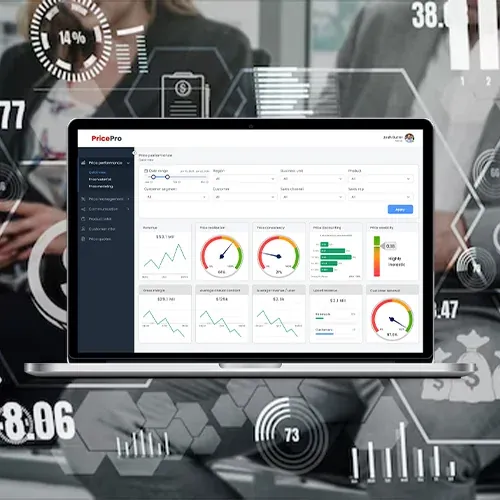
A new monetization model is fragile in its first year. Sales teams revert to the old model for difficult customers, exceptions accumulate, and the reporting still describes the business the old way. PricePro© holds the new structure in place at the point of quote and tracks the measures above by segment, so leadership can see whether the model is working without waiting for the quarterly accounts.
An engagement typically runs six to 10 weeks and leaves the leadership team with decisions it can act on, not a menu of options:
For software companies, the specific questions of value metrics and AI pricing are covered in our SaaS pricing strategy guide. Our monetization strategy guide covers the main model types with examples.
Tell us about the product, service, or capability you are trying to monetize. We will tell you which levers are worth testing and what evidence would settle the choice.
Before the build is committed, not after. Deciding the monetization route early changes what gets built: which capabilities go in the core, which become add-ons, and what needs to be measured so it can be billed.
Often, yes, if the service is valued and clearly defined. The usual route packages it as a level, such as a guaranteed response time or dedicated support, sold as an upgrade while the basic level stays included. Customers who valued it most tend to move first.
Test the offer with target buyers using structured research, then pilot it with a limited segment or region and compare the launch measures against a control group. A pilot of one or two quarters usually shows attach rate and churn clearly enough to decide.
Yes. Moving customers from one-off purchases to subscriptions, for example, can lower revenue in the first months while it raises lifetime value. The revenue model should show that dip explicitly, so it is a planned cost rather than a surprise.
No. Some of the clearest results in our case studies come from services businesses. The pest control plans above changed when households paid, not what they paid for. Any company that delivers value beyond the item it invoices has monetization choices to make.
