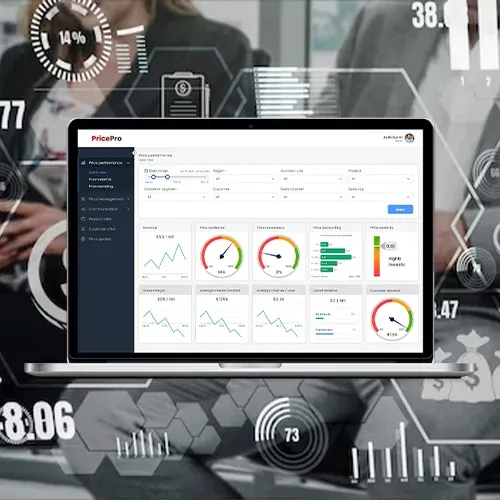
PricePro© is Acustrategy’s continuous pricing management platform. It brings pricing intelligence, pricing analytics, price optimization, and price governance into one AI-enabled system, built and supported by the same senior practitioners who design pricing strategies for mid-market and PE-backed companies.

Most of what is sold as pricing software was built for a shelf. It watches published prices and reprices thousands of items against competitors whose numbers anyone can see. B2B pricing works differently. Prices are negotiated, discounts sit in contracts and rebate files, and the figure a buyer compares you against is rarely published anywhere.
That gives B2B pricing software three jobs a retail repricer never has to do:
The rest of this page shows how PricePro handles each job, what a quarter of quotes looks like when all four modules work together, and when the platform is the wrong purchase.
The platform has four modules. Each answers one question a commercial team asks every week.
Module 1
Competitive price tracking, market alerts, trend identification, and anomaly detection. This is the ground that pricing intelligence software, price intelligence software, and price tracking software cover as separate products. In PricePro the market read sits beside your own deal history, which means a rival’s price change shows up where your next price gets set. Anomaly detection flags a sudden move, in a rival’s price or in your own win rate, the week it happens.
Module 2
Win and loss analysis by price point, discount effectiveness, customer price sensitivity, and revenue leakage identification. This is pricing analytics software and pricing analysis software in one: the continuous measurement and the closer study. Its core measure is price realization, the share of list value that turns into revenue, tracked by segment, product, and rep. Leakage is traced to the step where it occurs: invoice discount, rebate, freight, or payment terms.
Module 3
Price recommendations, scenario modeling and simulation, A/B test design, and margin impact forecasting. The engine turns deal history, value-based pricing inputs, and market position into a recommended price by segment, then shows the margin and volume consequence before anything changes. A built-in A/B test turns a disputed pricing question into an experiment. It is the same discipline as a price optimization engagement, run every week instead of once.
Module 4
Deal approval workflows, discount authorization levels, exception tracking, and compliance monitoring. The smart price calculator produces customer-specific, margin-optimized prices using approved logic and guardrails, and real-time governance alerts flag a deal that falls outside policy before it is signed. Change tracking records what changed, when, and who approved it. This is what price management software is bought for: pricing governance applied to live deals rather than written in a policy document.
Bought as separate tools, each module describes a problem the others would have to solve.
| Module on its own | What it produces | Why that is not enough |
|---|---|---|
| Analytics alone | A report of leakage | Nothing stops the next discount |
| Market monitoring alone | Headroom against competitors | The headroom never reaches a quote |
| Optimization alone | A recommended price | Sales negotiates it away |
| Governance alone | Enforced discount rules | Nobody checked the rules against the market |
Pricing strategies go stale for the same reason. Competitors change prices, customer needs shift, new products enter the market, and costs move. A strategy set once starts drifting the week it is launched. In PricePro the loop closes: the market read informs the recommendation, the recommendation reaches the quote, the guardrails protect it through the negotiation, and every outcome returns as data for the next recommendation.
A distributor issues 600 quotes a quarter, each worth $20,000 at list, so $12,000,000 of list value. Policy allows up to 15% discount with a manager’s approval. Cost of goods on each deal is $13,000.
Inside policy, 12% average discountPast the ceiling, competitor claim heldPast the ceiling, claim did not hold
420 quotes close at an average 12% discount. The other 180 close at an average 22%, well past the 15% ceiling, and the exception log shows most were approved with the reason “competitor is cheaper.”
| Group | Deals | Discount | Net revenue per deal | Gross profit per deal | Group net revenue |
|---|---|---|---|---|---|
| Inside policy | 420 | 12% | $17,600 | $4,600 | $7,392,000 |
| Past the ceiling | 180 | 22% | $15,600 | $2,600 | $2,808,000 |
| Quarter | 600 | $10,200,000 |
Price realization for the quarter is $10,200,000 / $12,000,000 = 85.0%.
Checked against the market read, the competitor claim holds on roughly half of the 180 deals. On the other 90, the competitor’s comparable price was no lower than your own price at the 15% ceiling.
Those 90 deals are held at the 15% ceiling, a net revenue of $17,000 and a gross profit of $4,000 each. The 90 deals where the competitor claim held stay approved as exceptions.
Extra revenue on the 90 deals: 90 x ($17,000 – $15,600) = $126,000 a quarter.
New quarter net revenue: $7,392,000 + (90 x $15,600) + (90 x $17,000) = $10,326,000.
New price realization: $10,326,000 / $12,000,000 = 86.1%, up 1.1 points.
Gross profit on those 90 deals rises from $2,600 to $4,000 each, a 54% increase per deal.
The obvious objection is that some of the 90 buyers will walk. The engine models exactly that. Today those 90 deals earn 90 x $2,600 = $234,000 in gross profit. At the ceiling, each deal won earns $4,000, so the rule still breaks even with $234,000 / $4,000 = 58.5 deals won.
It pays as long as no more than 31 of the 90 buyers leave, about a third of them. That is the number leadership decides on, before a single rep is told to hold price.
Two things make this a software problem rather than a one-off analysis. The split between real and claimed competitor pressure changes every quarter, and the rule only works if it is applied while the quote is still open. PricePro recalculates both continuously.
Buyers arrive through different search terms for overlapping problems, from plain price software to narrow tools for a single job. This is how the categories differ and where each sits in PricePro.
| What you are searching for | The question it answers | Where it sits in PricePro |
|---|---|---|
| Pricing analytics software | Is our pricing performing, week to week? | Performance analytics: realization, discount effectiveness, leakage |
| Pricing analysis software | What does a closer study of our pricing reveal? | Performance analytics: segment, customer, and price-point views |
| Pricing intelligence software | Where do we stand against the market? | Market monitoring: competitive position and trend identification |
| Price tracking software | What has moved, and when? | Market monitoring: price tracking and market alerts |
| Competitive intelligence software | What are rivals charging our buyers? | Market monitoring, aimed at price rather than messaging |
| Price optimization software | What should we charge? | Optimization engine: recommendations, scenarios, margin forecasts |
| Price management software | How do we control price changes and approvals? | Governance and control: workflows and authorization levels |
One boundary is deliberate. General competitive intelligence tools follow launches, news, and messaging for product and marketing teams; PricePro follows the price on the table, because that is the part that sets what you charge.
Most mid-market companies need three or four of these. Buying them separately is how a business ends up with several systems that each hold a different version of the truth. The consulting side of competitor pricing work, including how to normalize a competitor quote, is on our competitive intelligence page.
A PricePro rollout is measured in weeks, not quarters, because it runs on data you already hold. The work follows four steps.
Step 1
Connect the data.
PricePro links to your ERP, CRM, and CPQ with automated data ingestion, so it works from live deal records rather than an export that ages by the day.
Step 2
Build the picture.
The live KPI dashboard comes up first: realization, churn, elasticity, and deal profitability by segment, alongside the market read. This is usually where the first surprises appear.
Step 3
Set the rules.
Discount bands, authorization levels, and decision owners are configured, and the smart price calculator is loaded with the approved pricing logic, so a rep sees the allowed range while quoting.
Step 4
Keep it current.
Monitoring, alerts, and recommendations run continuously as costs, competitors, and demand shift, so pricing is reviewed on evidence rather than at the annual price-list update.

What leadership receives at the end of the rollout:
The average hides the problem.
Blended price and margin look healthy. Underneath, specific segments lose margin while others carry the business, and the blend is why nobody noticed. Realization by segment and rep makes the gap visible.
The competitor claim does not always hold.
Discounts granted because “they are cheaper” are rarely checked. Once the market read sits next to the exception log, the claims can be tested deal by deal, as in the example above.
Buyers pay for speed, and nobody charges for it.
In the rigging hardware engagement, customers put quote response time, availability, and support ahead of price and accepted higher prices for them. Performance analytics shows where that premium is being given away.
Across-the-board increases hit the wrong segments.
Both industrial manufacturers in the client’s case studies found that earlier price rises had cost volume in price-sensitive segments, while other regions were far less sensitive. Segment-level recommendations exist to prevent exactly that.
The data already exists.
Very little needs building. The pricing, discount, and deal data is in the ERP and CRM already. It has simply never been in one place at one time.
The policy was never applied.
There is usually a discount policy. There is rarely a system that applies it during quoting, so approvals follow pressure instead of rules. The exception log shows how often, and who signed off.

Nothing gets replaced. PricePro adds the pricing layer on top of the systems your commercial teams already use.
Different roles use it for different things. Leadership gets one source of truth for pricing decisions and a faster response to market changes. Pricing and finance teams get automated routine analysis and a way to track and prove impact. Sales teams get clear pricing guidance and faster quote approvals, which matters more to a rep than any dashboard.
Standalone subscription
The platform, run by your team
Suited to: Companies with internal pricing expertise and a named pricing owner
Bundled with a consulting engagement
The platform set up with the pricing strategy we design together
Suited to: Companies changing their pricing and wanting the new rules enforced from day one
Managed service
Setup, training, and ongoing optimization run by Acustrategy
Suited to: Companies, often PE-backed, with no dedicated pricing function
The bundled option exists because the most common failure of a pricing project is what happens after it ends. When the rules from a pricing strategy engagement are loaded straight into the platform, the structure you designed is the structure that reaches the quote. The managed option serves the same purpose where no internal owner exists yet.
Software cannot fix a pricing structure that was never decided. We say so when it applies.
There are no pricing rules yet.
If nobody can state the discount bands, the price floors, or who approves an exception, the platform has nothing to enforce. Start with the strategy; the software follows.
Prices are published and identical for every buyer.
A business selling a catalog at one visible price to everyone needs a repricing tool, not a platform built for negotiated deals.
Nobody will own the decisions.
Alerts that nobody acts on are noise, and an exception log that nobody reviews only records the leakage. Either name an internal owner or choose the managed option.
The data problem is bigger than the pricing problem.
If invoice lines do not record list price, discount, and approver, fix that first; it is part of our data and tech enablement work.
Across active users, Acustrategy reports these typical ranges for PricePro: 3 to 7 points of pricing precision, 2 to 5 points of price realization, up to 60% reduction in margin leakage, and up to 80% faster pricing decisions. These are the firm’s own typical results, not a guarantee, and the outcome for any one business depends on where its pricing starts.
The platform embeds decades of pricing expertise, best practices, and AI-based insights into day-to-day execution. In one consulting engagement with a rigging hardware distributor, the team built price calculators, KPI dashboards, and web scraping for competitor price intelligence as part of the work, and the client reported an 8.1% gross margin uplift in the first year, with pricing compliance rising from under 40% to 77% of transactions. The same senior team that builds pricing strategies supports the platform that keeps them in force.
Talk to the practitioners behind PricePro about how it would run on your pricing data, which of the three options fits, and where it would protect margin first.
A BI tool reports whatever you build into it. It has no market read, no recommendation, and no way to stop a discount while the quote is open. PricePro starts from pricing logic: the waterfall, the discount bands, and the approval rules are part of the platform.
No. The CPQ builds and sends the quote. PricePro decides what the quote should contain: the recommended price, the allowed discount, and the approval needed if a rep goes further. The two work together through the integration, so reps do not switch tools.
Invoice-level transactions with list price, net price, discounts, and rebates, plus the rep, approver, and customer on each deal, and standard cost by product. Two years of history is a good start because it covers a full renewal and price-increase cycle. Gaps in the data are recorded as findings, not blockers.
The platform runs with enterprise-grade security and role-based access control. A rep sees the guidance for their own deals; margin and cost detail stays with the roles that need it, such as finance and pricing leadership. Change tracking also records who approved each price change.
From competitive price tracking and market alerts on one side, and from your own win and loss outcomes by price point on the other. The second source matters in B2B because competitor contract prices are rarely public, while your own lost deals show where the market is pricing below you.
Against the baseline set in the first weeks: price realization, discount depth, exception volume, and deal profitability by segment. Because the dashboard is live, the comparison is visible month by month rather than at the year-end review.
The managed service covers setup, training, and ongoing optimization, and the standalone subscription is designed for companies that have their own pricing expertise. Moving between the two as the internal function grows is a scoping conversation we have at the start.